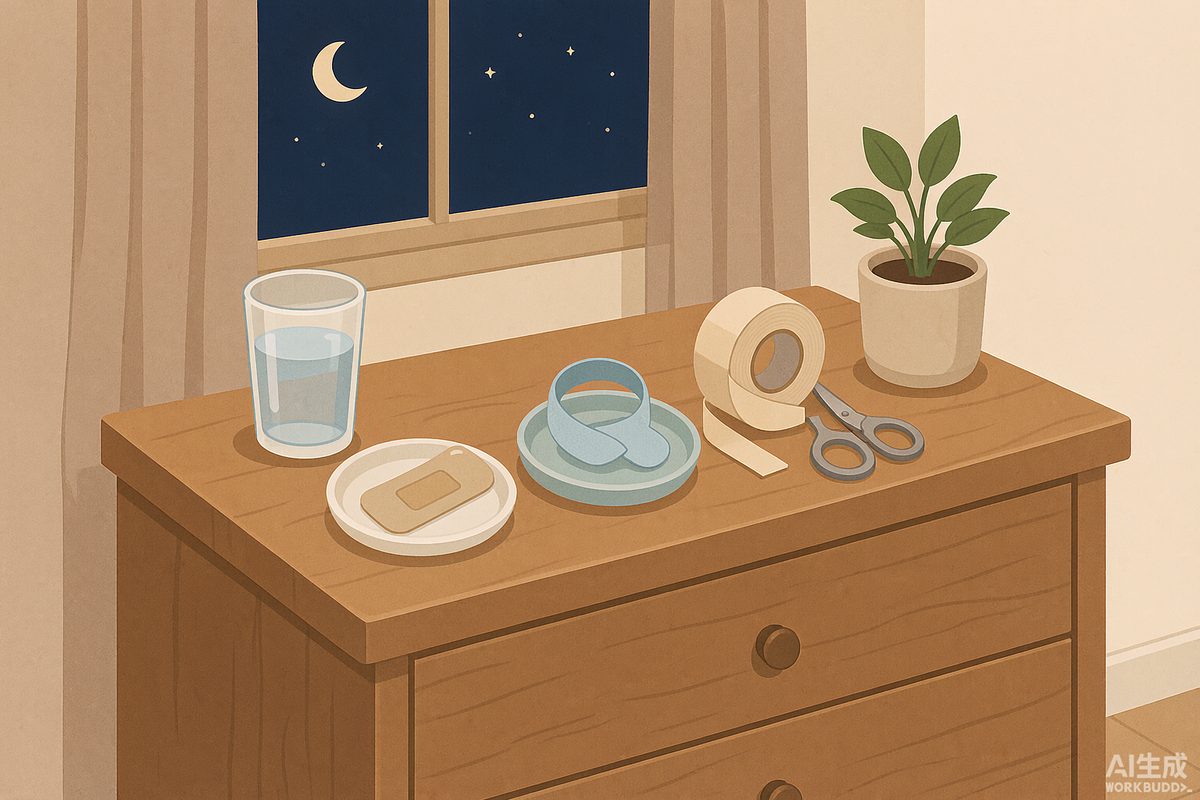
You already know the theory — our mouth taping guide covers the why. This page is about the buy: which tape actually stays on, which one will not wreck sensitive skin, and which design gives you an escape hatch if your nose blocks at 3am. Those details matter more than brand names, because the difference between a great night and a terrible one is usually the tape's design, not the brand's marketing.
We compared the category on the one dimension most reviews skip: what happens when something goes wrong mid-sleep. Vented strips give you a built-in air path. Loop tapes never fully seal. Solid strips rely on you waking up — which you will, but it is worth knowing which camp your tape sits in before you buy.
Before You Buy: The 30-Second Safety Check
Mouth tape is a cue, not a seal — but it still demands one condition: a clear nose. Do not tape if you have nasal congestion, a significantly deviated septum, diagnosed or suspected sleep apnea, or if you have had alcohol or sedatives. Undiagnosed loud snoring deserves a sleep apnea screening first — taping over a real airway problem is the one genuinely dangerous mistake in this category. If you are new to the practice, our step-by-step taping walkthrough covers the daytime trial and removal technique.
The 6 Best Mouth Tapes of 2026
1. Somnifix Sleep Strips — Best Overall (and the Only One Clinically Studied)
Somnifix is the most credible product in the category. It is the only mouth tape with published clinical research — a 2022 pilot study in the Journal of Clinical Sleep Medicine found significant reductions in snoring frequency and mouth breathing in non-apneic snorers. The design explains the trust: an hourglass strip with a central breathing vent, medical-grade silicone adhesive that bonds firmly but peels cleanly, and FDA Class I registration.
The vent is the feature that converts skeptics. If your nasal passage narrows mid-sleep, air still moves. The trade-offs: the vent slightly reduces sealing effectiveness versus solid tapes, and at roughly $0.90 per strip it is pricier than DIY options. For beginners and anyone who values the safety margin, it is worth every cent.
Check Somnifix price on Amazon
2. MyoTape — Best for Beginners, Sensitive Skin, and Beards
MyoTape, designed by Patrick McKeown of Buteyko Clinic, takes a fundamentally different approach: a thin loop that wraps around the lips instead of across them. No adhesive touches your lips at all. The tension gently cues your lips closed while leaving you free to open your mouth, sip water, or breathe in an emergency — the least claustrophobic design on the market.
That open design makes it the pick for three groups: first-timers (nothing to fear), sensitive or reactive skin (minimal adhesive contact), and anyone with a beard (it anchors to skin the razor never touched). Over 27 million units sold, with a 94% customer satisfaction claim behind it. The downside is sealing power — heavy, habitual mouth breathers may pop through it. Start here; graduate to Somnifix if you need more hold.
3. Hostage Tape — Strongest Hold for Heavy Mouth Breathers
Hostage Tape is the social-media giant of the category, and its reputation rests on one thing: the strongest adhesive in the business. The flexible fabric strip covers the full lip area with no vent, engineered for people who found lighter tapes failing by morning. If your mouth pops open through vents and loops, this is the one that finally holds.
Honest caveats: the adhesive can irritate sensitive skin, there is no safety vent, removal takes more care (our walkthrough's warm-water technique helps), and the brand carries a BBB D rating with no published safety certifications. This is a tool for experienced tapers with clear nasal airways — not a first tape. The 30-night money-back guarantee softens the risk.
Check Hostage Tape price on Amazon
4. 3M Micropore Paper Tape — Best Budget (Pennies per Night)
Before purpose-built tapes existed, sleep specialists and Buteyko practitioners recommended exactly this: a roll of 3M Micropore paper tape, cut to size. It costs pennies per night, the paper body breathes naturally (which reduces the sealed-in feeling for beginners), and the hypoallergenic adhesive is genuinely gentle — gentler than most branded strips.
What you give up: no safety vent, no engineered shape, and a hold that weakens on oily skin or restless nights. Cut a strip about 1.5 inches long, fold a small tab at one end for easy morning removal, and apply horizontally. If you are unsure mouth taping is for you, spend $8 here before spending $25 anywhere else. (Skip generic surgical tapes — many use adhesives never intended for facial skin.)
Check 3M Micropore price on Amazon
5. Dryft Sleep — Best Premium Comfort
Dryft sits in the premium slot with a spec sheet that reads like a Somnifix rival: gentle silicone adhesive, a built-in breathing vent, and a beard-friendly design. In independent testing it scored well on comfort and safety, with the one recurring complaint being hold that weakened on restless nights — the same trade every vented silicone strip makes for skin-friendliness.
Choose it over Somnifix if you have a beard or found Somnifix's hourglass shape uncomfortable, and you want the vent anyway. It is the comfort-first option for people who have already committed to the habit.
Check Dryft Sleep price on Amazon
6. Sleep Karma — Best Newcomer (ISO-Certified Adhesive)
The newest credible entrant. Sleep Karma pairs an ISO-10993-certified adhesive (the medical-device biocompatibility standard) with a breathable bamboo-silk fabric, and scored the highest overall rating in the largest independent 46-brand comparison we found — with testers praising painless removal and zero residue. A 30-night supply runs about $24 with a bamboo nightstand holder included.
The caveats: no breathing vent option, availability is mostly direct-to-consumer rather than Amazon, and the brand is young with a shorter track record than Somnifix. If adhesive safety certification is your top priority, it is worth a look; otherwise Somnifix remains the safer bet.
Check Sleep Karma price on Amazon
How to Choose: Match the Design to Your Situation
- Never taped before? MyoTape (nothing covers your mouth) or 3M Micropore (cheap experiment). Do a daytime trial first — see the walkthrough.
- Wake up with a dry mouth every morning? You are a committed mouth breather. Somnifix gives you the strongest evidence-backed seal with a safety vent.
- Sensitive skin or facial hair? MyoTape or Dryft — minimal adhesive contact, no lip coverage.
- Tried everything and still wake up open-mouthed? Hostage Tape is the last resort by design. Confirm your nose is clear before choosing it.
- Budget testing the waters? 3M Micropore at pennies per night beats every "starter pack" on price.
Mouth Tape vs Nasal Strips: Do You Need Both?
These solve opposite halves of the same problem, and our side-by-side comparison breaks it down fully. In short: nasal strips pull your nasal passages open to improve airflow in; mouth tape keeps your mouth closed so air goes through the nose you just opened. For mouth breathers with stuffy noses, the combination outperforms either alone — strip on the nose, tape on the lips, and the whole system points one direction.
Stack It Into a Full Sleep Setup
Mouth taping pairs naturally with the other low-cost sleep upgrades we cover:
- Light control: A weighted eye mask adds gentle pressure and total darkness — the tactile complement to nasal breathing.
- Sound control: If a partner's snoring is what you are taping against, our brown noise vs white noise comparison covers masking it from your side of the bed.
- Recovery: Magnesium glycinate before bed addresses the muscle-tension side of sleep quality that tape cannot touch.
Care and Usage Tips (Learned From 1,000+ Taper Reviews)
- Prep beats pressure: Clean, dry skin holds tape all night; lotion or lip balm on the application zone guarantees 2am failure.
- The courtesy tab: Fold a small section of any tape onto itself before applying — a non-sticky handle for painless removal.
- Patch test every new brand: Inner arm, a few hours, before it goes near your face. Adhesive sensitivity is the #1 reason for one-star reviews.
- Sick nights are no-tape nights: Congestion changes the math completely. Skip it, sleep worse, live longer.
Frequently Asked Questions
Is mouth taping safe?
For healthy adults with clear nasal airways, yes — with a daytime trial first. It is not safe with nasal congestion, suspected sleep apnea, alcohol, or sedatives. The tape is a habit cue, not an airway seal, but respect the contraindications.
What is the difference between vented strips and loop-style tapes?
Vented strips (Somnifix) seal over the lips with a central breathing hole — strongest cue plus emergency airflow. Loop tapes (MyoTape) wrap around the lips and never fully seal — best for beginners, sensitive skin, and beards.
Can I just use regular medical tape?
3M Micropore paper tape is the classic budget route and genuinely works — hypoallergenic, breathable, pennies per night. What you lose is the engineered shape, safety vent, and overnight hold. Avoid unknown surgical tapes.
How long until it feels normal?
Most people adapt in 3-10 nights. Napping with tape on is the fastest on-ramp. Still claustrophobic after two weeks means the tape is too strong for you, not that taping is wrong — drop to a loop design.
Will mouth tape stop snoring?
Only mouth-breathing snoring. The 2022 Somnifix pilot study showed real reductions in non-apneic snorers. Jaw-position or tongue-collapse snoring will not respond to tape — and loud chronic snoring warrants an apnea screening before you tape anything.
What if my nose blocks during the night?
Vented tapes give you a built-in air path; loop tapes never seal at all. With any tape you will wake long before any real oxygen issue — but the correct answer is prevention: no taping on congested nights.